
This is an old revision of the document!
Personal Vehicles for Solarpunk Settings
Personal vehicles in solarpunk?
In a solarpunk world, most personal travel should be feasible with public transit in one form or another, whether that's trains, trams, streetcars, buses, ropeways, ships, ferries, airships. Similarly, most cargo is likely moved by ships, trains, airships, freight trams or similar efficient systems.
But even an effective, well-resourced public transportation network will have gaps, places where the last-mile problem shows through, whether that's personal conveyance for people with disabilities and other needs, people trying to transport heavy cargoes from the docks or trainyard to a workshop or home, or, in rural areas, farmers, forest managers, and others whose work/lifestyle takes them impractically far from public transit.
This page will explore the types of vehicle which might make sense in these use-cases. There are some fun opportunities from a writing/worldbuilding standpoint here. The changes to a setting which which make it solarpunk will likely turn cars from an expensive necessity to a rarity and can easily allow for a handful of vehicles (in the correct niches) with much more individual character.
The Problems Today
Over the last hundred years cars shifted from luxury to necessity - a big part of that transition was accomplished by reshaping all of society around them. Prior to mass adoption of the automobile, cities and rural areas were generally developed on a human scale, around walkable distances and available mass transit. Once personal vehicles were common, roads were widened, huge swaths of land were dedicated to parking, and most crucially, the distances between things stretched out in a way that made accomplishing even basic tasks (like going to work or the store) difficult without a car. We cover this a bit more thoroughly in our sections on exurbs and how they might change in the solarpunk transition. But we're here to talk about the vehicles themselves, so lets do that:
In the modern day, vehicle designs have taken on a degree of sameness, mostly due to safety requirements and the fact that most vehicles intended for regular people are trying to do every job at once. Whether it's a small sedan or a giant pickup truck it needs to be built to transport around five people and a fair bit of cargo, to travel safely at highway speeds, and to protect its passengers during a head-on collision there. Emissions requirements and fuel efficiency needs (because many places become non-viable if you can't afford to drive) add complexity and cost.
This is reinforced by auto manufacturers favoring large, expensive vehicles (largely due to an emissions regulation loophole in the US) with luxury features included even in base models -if you can only afford one vehicle, you need it to do every job.
These overlapping, sometimes conflicting requirements lead to some odd outcomes, like huge, low-gas-mileage pickup trucks designed with tiny cargo beds to fit a large passenger cab, and an ever-larger-vehicle arms race where even basic passenger sedans and hatchbacks are made far larger than they need to be because larger vehicles are generally safer in a high speed collisions.
Personal Vehicles in a Solarpunk Setting
In a world without freeways, where most people have other options for transportation, and especially where long-distance, high-speed transportation is done using public transit, it should be possible to disconnect and even drop some of these requirements from personal vehicles. If so, the remaining vehicles could be made more simply and cheaply to do a single job and, in the right niches, we might actually see more variety overall.
In cities and towns, With most transportation handled by public transit, car-ready streets are likely going to be de-prioritized, if only as a matter of cost/resource allotment. More likely they will be shrunk down to make room for parks, gardens, and sponge-city permeable surfaces and basins, leaving something wider than a bike path, but narrower than our current car-centric default. These remaining road networks would be used mostly to reach local destinations and public transit hubs, and the vehicles on those roads would generally travel much slower. These vehicles will cover everything from micromobility to last-mile cargo transportation.
In rural areas, we might see a dramatic reduction in the quality and coverage of the road network once cars stop being the default, and a matching reconfiguration of how our communities are laid out towards denser villages with public transit, and more farmland and rewilded habitat between them. In town the vehicles will likely match the city list below, but outside of them there are some interesting options for specific jobs and for long trips to more isolated farms, work sites, homesteads, and other holdouts.
Get to the Vehicles Already!
In Cities and Towns
It's hard to separate cargo and passenger transportation in this context - even a bicycle can be a tremendously effective way to move a sofa - so the following options are sort of a mix grouped more or less by size.
Bikes and Scooters
We're starting off with the obvious ones, bicycles, scooters, electric scooters, electric mopeds, e-bikes, cargo bikes, cargo e-bikes. These vehicles are cheaper to design, build, and maintain, they fill many of the same roles cars do today, and they're already making an outsized dent in the world's demand for oil. They make a lot of sense for cities built at a human scale. And if your setting is recovering from the climate disaster or other societal crumbles, and especially if your setting has other shortages which are putting pressure on the public transit network, these vehicles are a simpler way to provide independent transportation while rebuilding everything else.
A common sentiment I've found while reading about electric bikes is that they actually offer the same freedom and convenience once promised by the automobile, without the tremendous cost of purchase and upkeep, and the general stress of traffic and parking.
They're also fantastically changeable, with thousands of DIY variations and modifications for all situations. Cargo bikes especially see a wide array of mods for increased capacity.
Bike-ish Contraptions
I'm not really sure what else to call things in this category, but it's by far the broadest one to cover. The general idea is that they're too small, “unsafe,” and DIY to be modern cars, but a bit too big or fast to fit in the narrow bike lanes and paths that bicycles etc are currently constrained to. If city streets in your setting have fewer cars and lower speed limits, there would be more room for people to build all sorts of things to suit their needs for local transportation and cargo capacity.
In real life there are a dizying array of examples from alternative vehicle competitions - hybrid electric, solar, and pedal-powered machines sort of partway between a bike and a car. The big hurdles for using these vehicles on the road today are requirements for speed (so you can take them on freeways), and collision safety, which can be reduced if vehicles are only used for local, low-speed transportation. If it helps, think of this as starting over from bicycles/e-bikes and slowly scaling up to fit any niche that trains, buses, streetcars, trams, freight trams, and airships can't cover.
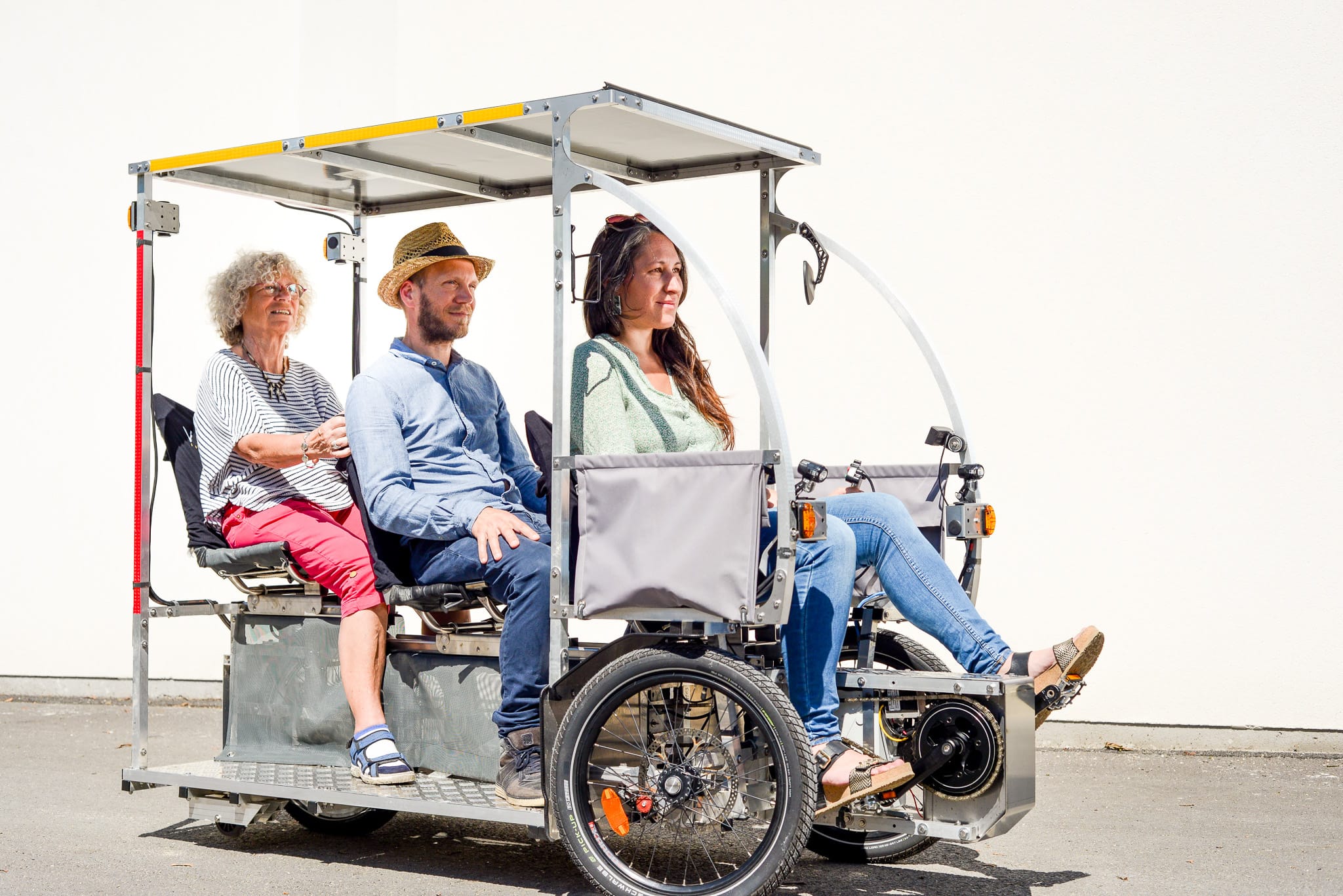
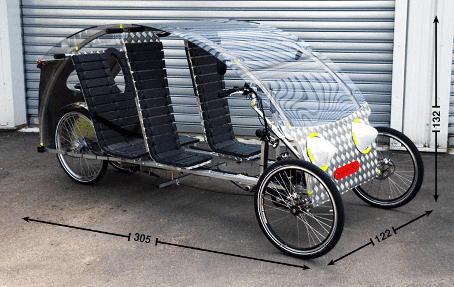
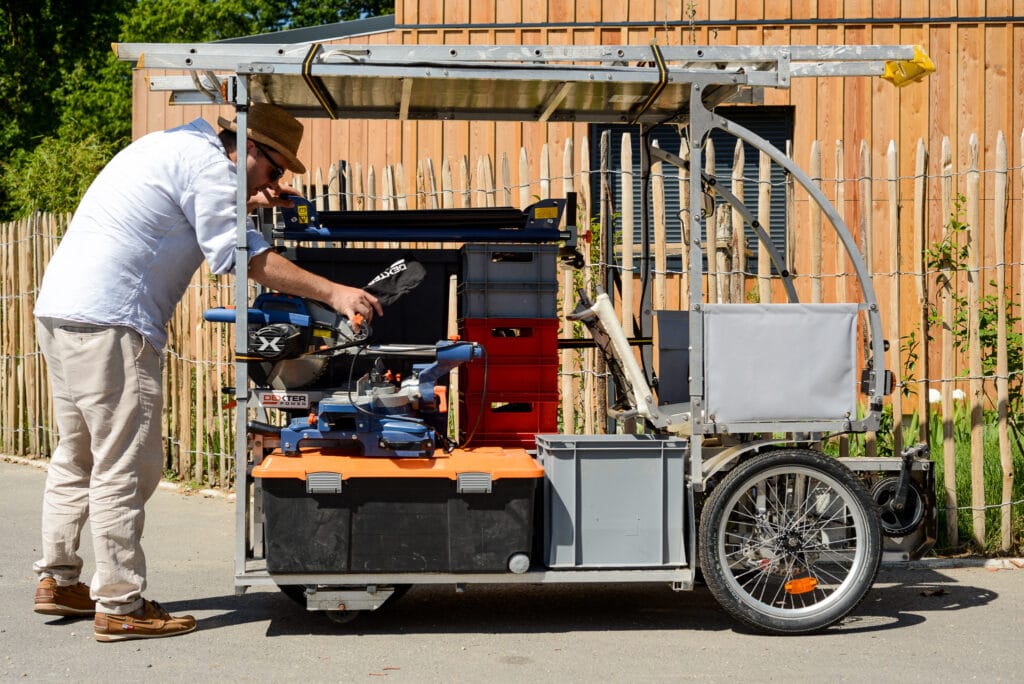
The vhelio modular solar electric/pedal hybrid vehicle admittedly looks rather crude, but it's a solid fit for some solarpunk settings: it's open source, and can be built from a wide array of parts using common tools, and it offers a surprising variety of configurations. It seems reasonable that some descendants of it, perhaps a bit more developed, might be common on streets in a recovering future.
The four-wheeled, cargo-hauling, recumbent velov armidillo bicycle cart seems to occupy a similar space in that it's a bit large for modern bike paths but fine on roads with light car traffic.
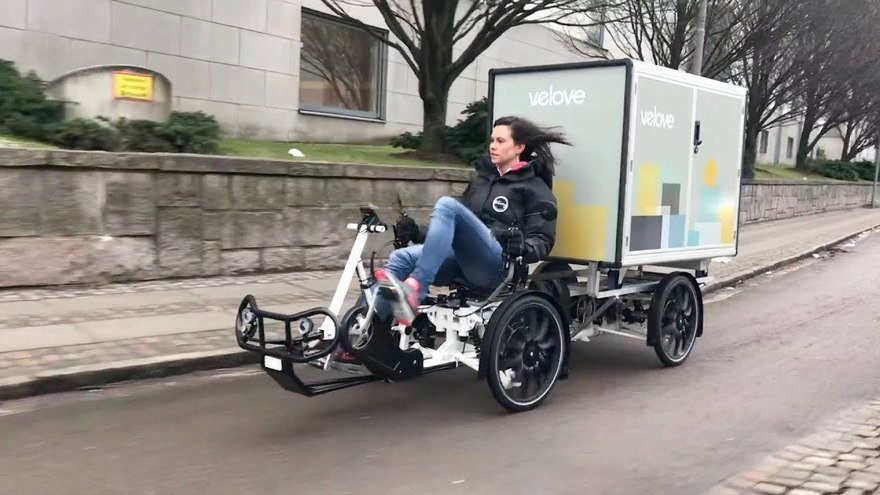
There was some discussion on this reddit thread about bicycle-scale containerization (essentially bringing lessons from the big universal shipping containers that stack on ships, attach to railcars and truck beds over to smaller vehicles). Perhaps a solarpunk setting could build a system where these recumbent cargo delivery bikes and small cargo ships like the harryproa use the same small containers.
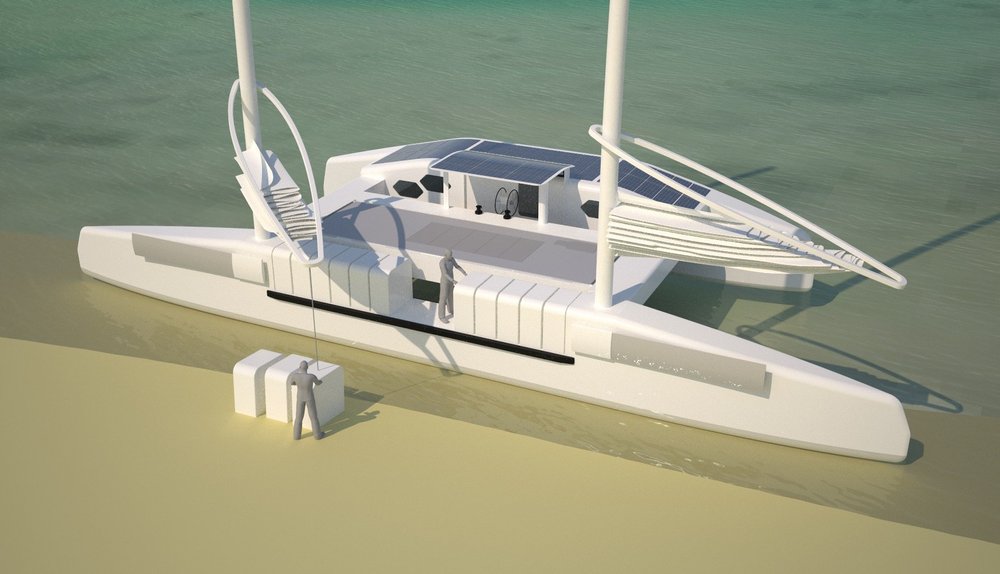
I'm not sure how much taxonomic difference there really is between ebike tricycles and electric rickshaws which have their own section, but the seem to have similar size and capabilities.
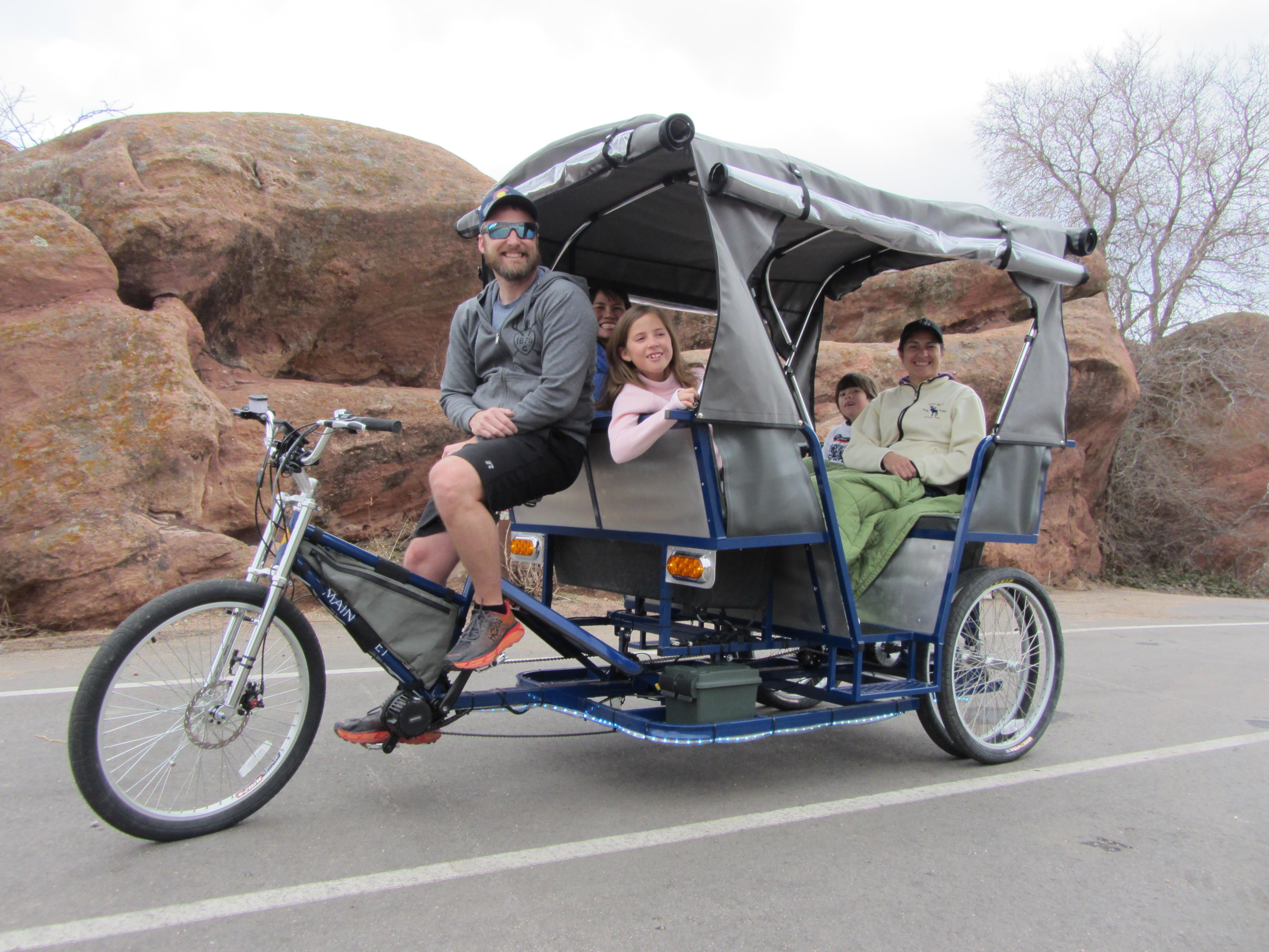
If you're looking for a possible point of contention within towns, a debate over whether mini-car-like things like the UD MUUV Velocar are just restarting the automobile could be interesting:
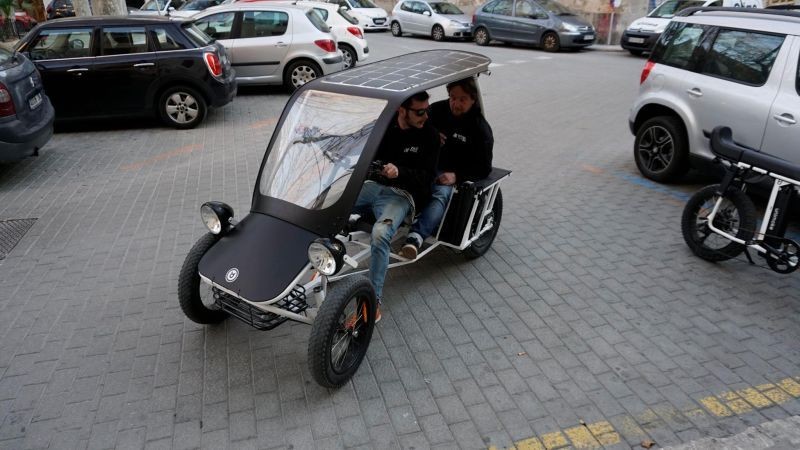
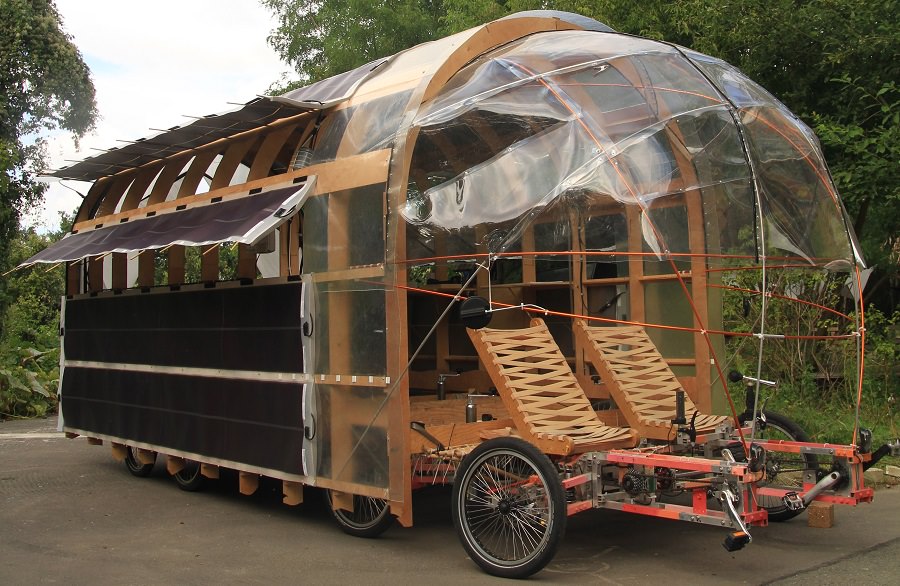
For something that transports cargo and can definitely only fit on a road, there's the 8rad, an 8-wheeled, bicycle-powered car-sized cargo contraption.
Electric Rickshaws
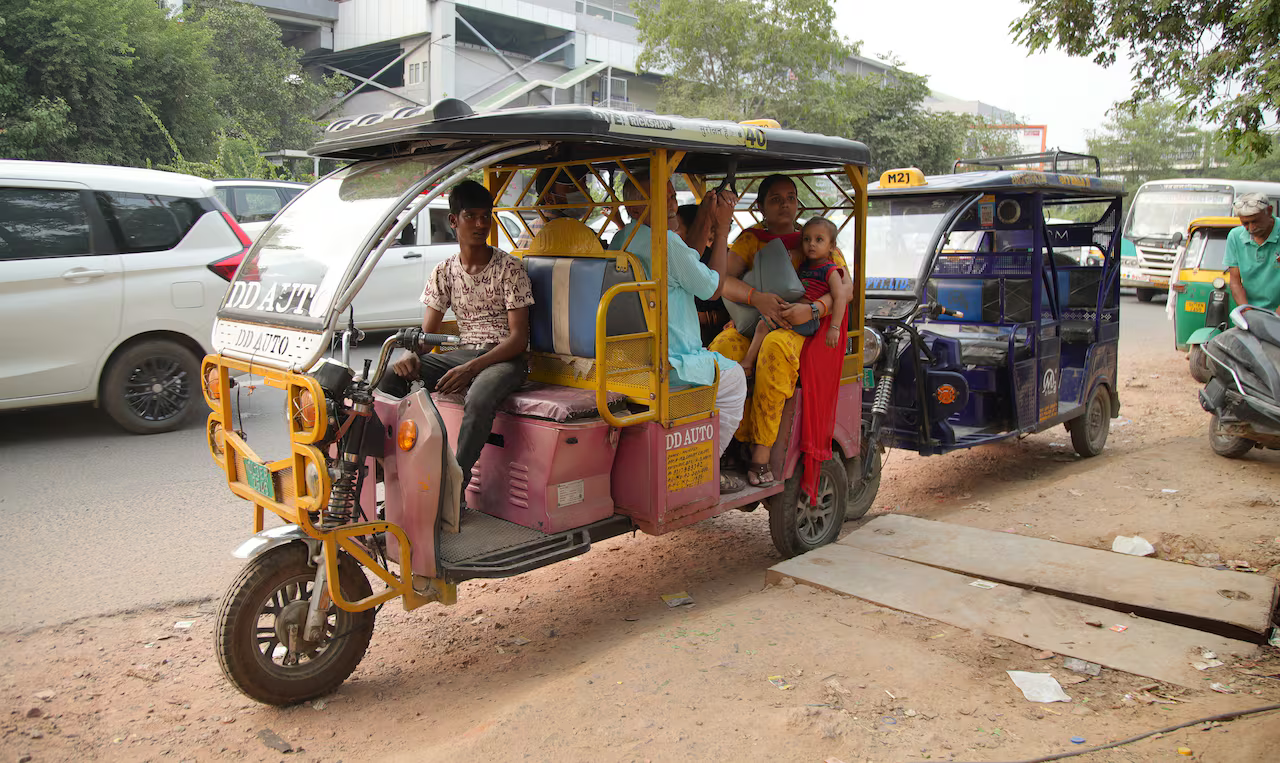
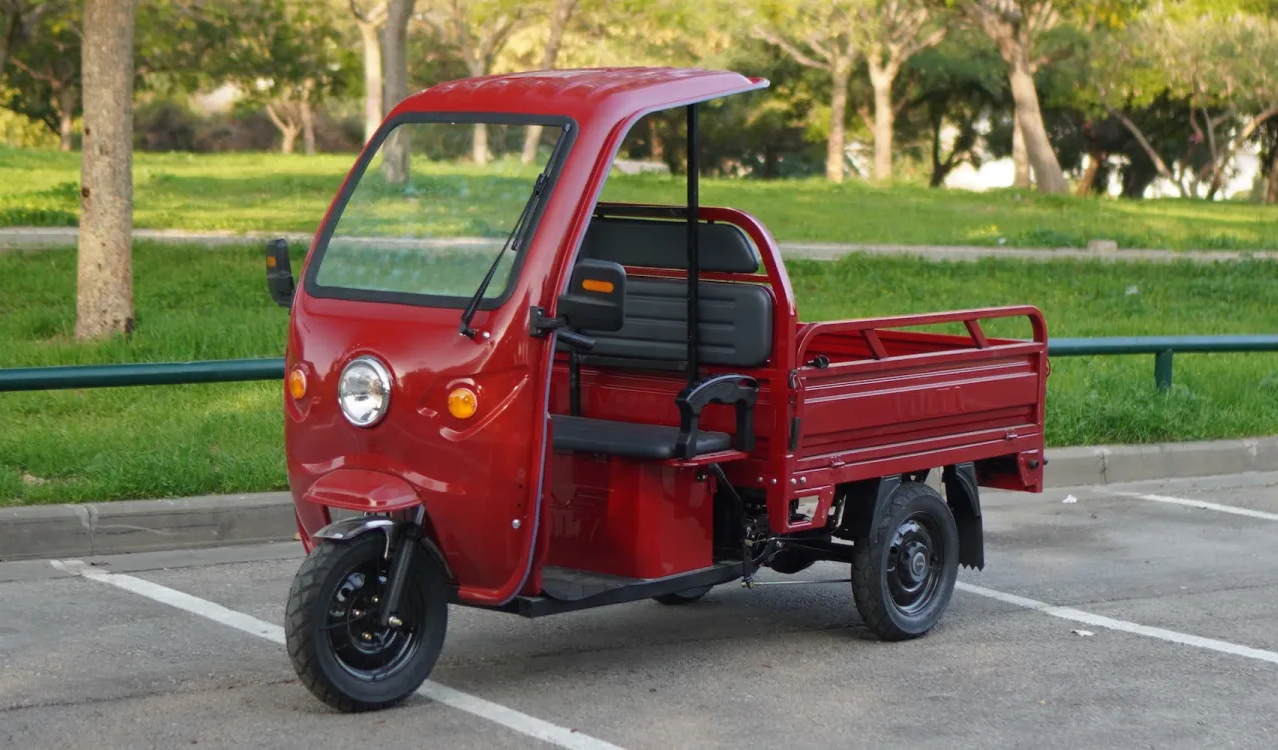
Scaling up a little, electric rikshaws are a practical city vehicle, with a small overall size and good maneuverability, but with large carrying capacity. They have a fantastic variety of configurations and a lot of personality, seeing use as passenger taxis, cargo haulers, food trucks, and more.
Golf Carts and Other Low-Speed Electric Vehicles
Already a staple of places with low speed limits and few vehicle requirements, golf carts and electric utility vehicles make plenty of sense within towns. These mass produced vehicles are relatively easy to maintain and modify, and might easily be salvaged and put to new use. Perhaps they would even see the extensive variety of mods and purposes rickshaws are put to, especially in areas without a history of using rickshaws.
Trucks
As work vehicles hauling cargo, trucks make a lot of sense, and they'd almost certainly still be around for last mile transportation, even in a setting where most cargo transportation is handled by ships and trains (for example, moving stuff to and from trainyards or docks, between workshops and homes, etc). There's some overlap here with cargo bikes, cargo rickshaws, etc, but when it comes to moving cargo there's something to be said for size. We might be stretching the 'personal vehicle' designation a bit here - its quite possible these trucks would actually be owned/maintained by a vehicle library which provides them when someone needs to move something, by municipalities or operators in a library economy for making pickups/deliveries, or by co-ops who use them for transportation of goods and supplies.
As for what they would look like - if we didn’t need every vehicle to be able to fly down freeways and survive 180-mile-per-hour crashes, they could be much simpler than what we have now. To fit the city scale we might see more electric kei trucks (with small cabs, large beds, not intended to double as a mini van or daily driver). This article had an interesting example: https://slrpnk.net/post/11465754
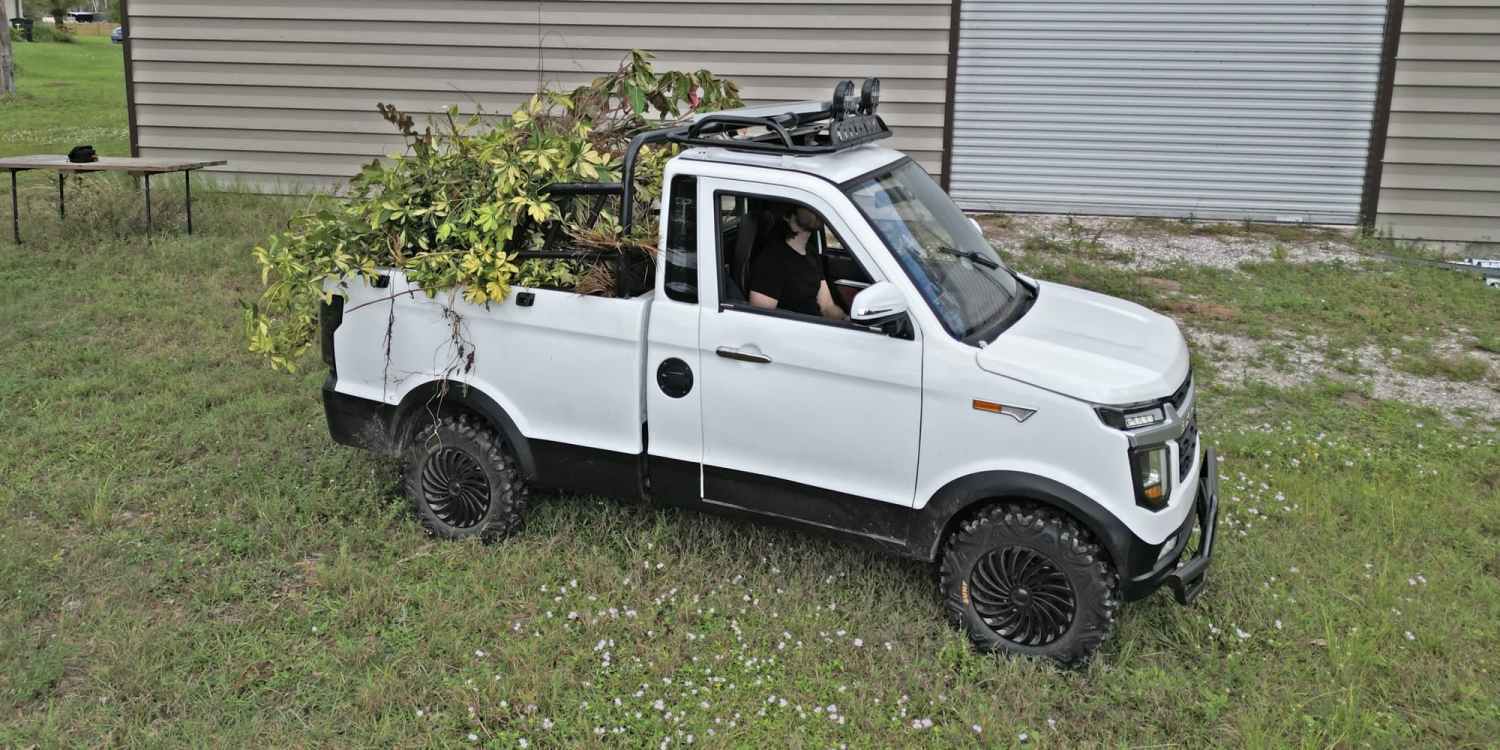
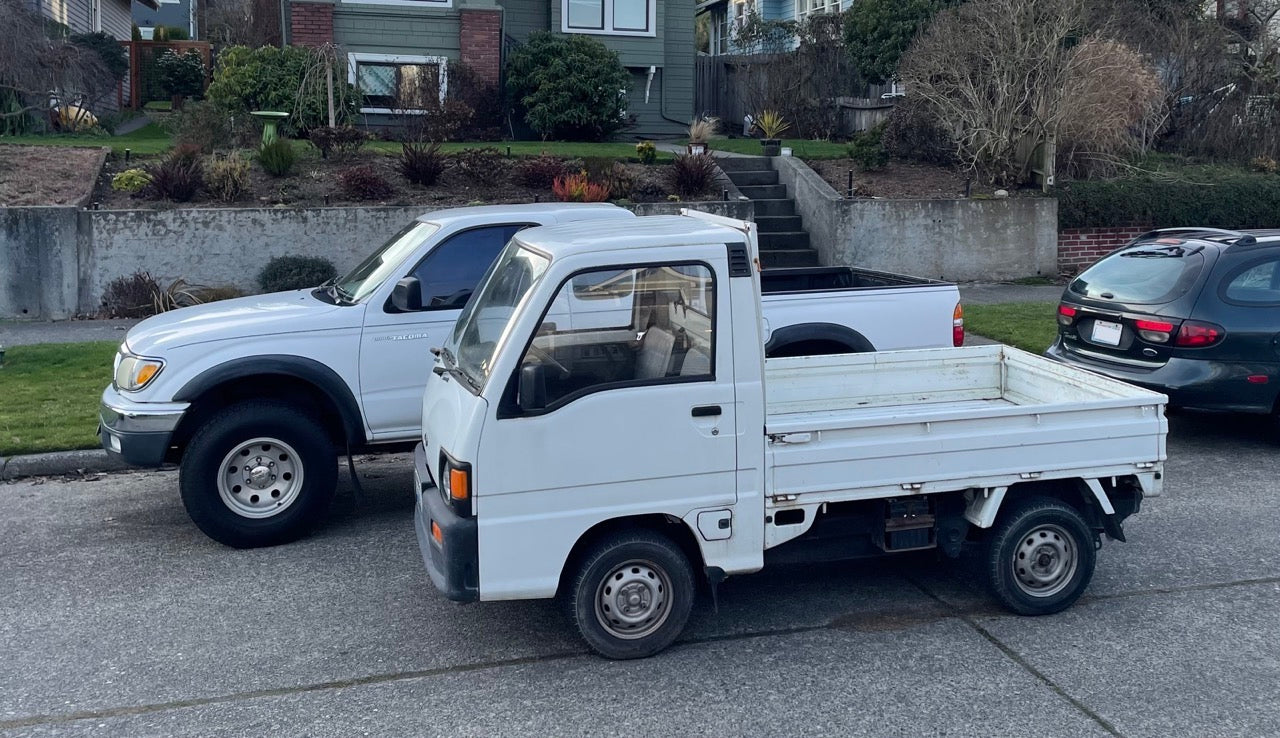
Most existing kei trucks (like the second one pictured above) run on gas right now but there are also some electric conversion possibilities for these trucks:
For something larger, electric versions of regular pickup trucks, flatbeds, box trucks, etc are all quite reasonable. If they're municipal or municipal-adjacent (perhaps part of the collection or distribution network for a library economy), some of these electric vehicles could be equipped with pantograph rigs to enable them to connect to the overhead catenary systems used by streetcars and some electric buses. Much like a trolley bus can raise and lower its photograph to connect to lines as it approaches or leaves them, these trucks could connect and disconnect as necessary, and thus get by with a much smaller battery by mostly running off the grid.
Rural Areas
Outside of towns, there will be even more need for personal vehicles. Some would be maintained for specific tasks (such as construction), some by hobbyists, and some by farmers, researchers, forest managers, and others whose work takes them impractically far from public transit. In some ways, the rarity of personal cars and trucks would return them to being the luxury they once were.
The variety of vehicles will largely depend on the state of the roads. The closer to the modern day they fit, the more stringent the requirements on their design and maintenance. If the condition of the roads effectively enforces a lower speed limit, of if vehicles are less regulated in these regions, then the vehicles which remain can be much more interesting.
Electric Vehicles
There's an important theme to consider with rural areas, in that a lot of solarpunk practices are effective enough that you can arrive at them from a variety of ideological starting points. For people interested in rugged self sufficiency, electric vehicles can make some good sense, as it's easier to make your own electricity than it is to make your own gasoline or diesel.
Options here could include regular electric cars/trucks and motorcycles. These vehicles can be designed to be repairable and modular in a way that matches a lot of solarpunk ideals around long-lasting designs. (Some older internal combustion engine car designs are so well-documented and supported by such a large third-party spare-part manufacturing base as to be essentially open source already). But modern electric vehicles are often well-protected against repair by home mechanics and even independent auto repair shops. Simpler, open source designs could be a big improvement, and may be more viable if the requirements/expectations are generally lower in a less car-centric society.
If the roads are in rougher condition, you may want to look to options which are currently classed as off-road vehicles: electric dirtbikes and ATVs, electric utility vehicles, electric snowmobiles, and of course, electric trucks and SUVs with offroad modifications. For someone making a day trip into town on washed-out, muddy trails, any of these could be viable depending on their needs.
Woodgas Conversions of Internal Combustion Engine Vehicles
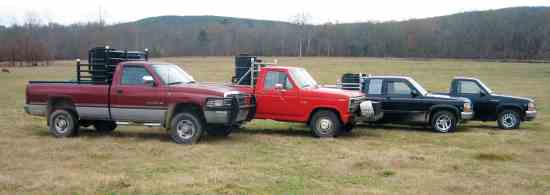
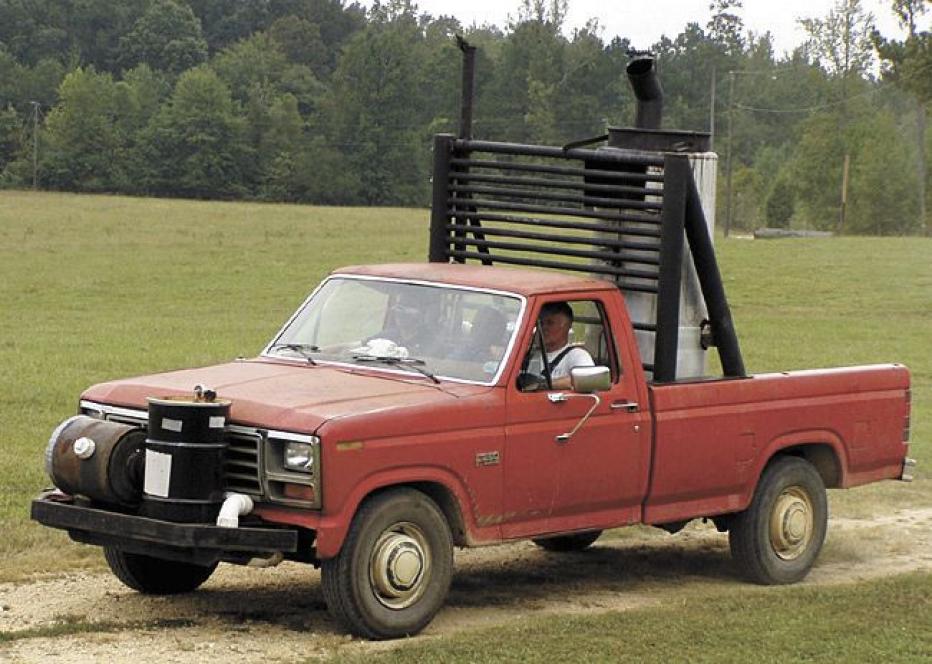

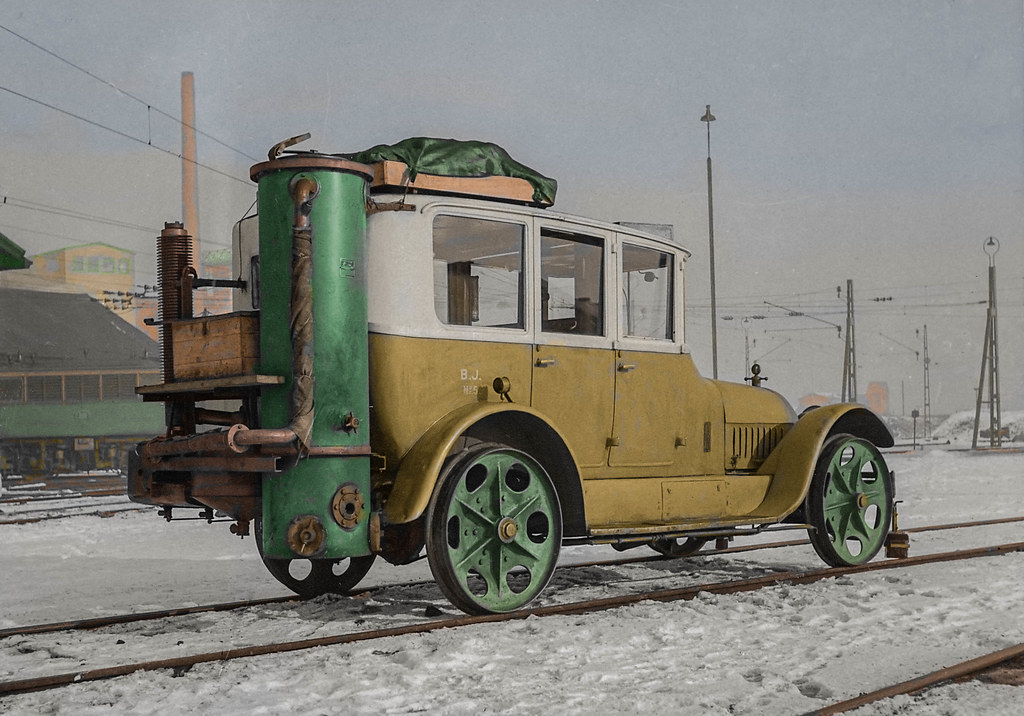
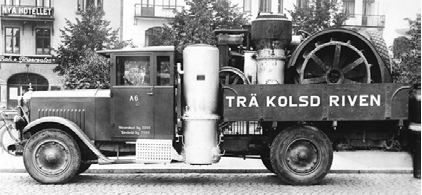
If you favor a near-future, salvage-heavy, better-but-not-perfect type of setting, woodgas conversions of existing vehicles may be a good fit. These trucks use a special sort of stove to break combustion of firewood or other burnable material into multiple stages, extract hydrogen and carbon monoxide gas, and pass them to the engine in place of gasoline. This sort of DIY modification emphasizes reuse of existing machinery (and its embodied carbon) instead of new manufacturing. It also doesn’t require high-tech electronics like electric vehicles - building and maintaining a woodgas conversion is attainable for regular people who are comfortable working on cars (and assuming they have access to old ICE vehicles and parts).
One of their big advantages for a solarpunk writer or artist is that they're not really a drop-in replacement for a regular Internal Combustion Engine vehicle in the way that modern electric vehicles are. This is mainly because they're less convenient: A woodgas vehicle takes awhile (generally ten to twenty minutes to start up) because you have to build up a fire and get it up to temp before there's enough combustible gas to run the engine. They also take awhile for the fire to burn down when you're done (during which time they can't be parked indoors for safety reasons). That makes it a fine fit for special trips, and for continuous operations, such as transporting workers and lumber between a work site and town all day. This makes them less practical for the kind of quick trip to the store or daily commute which has shaped our current society but then most people in a solarpunk society shouldn’t need a car for those tasks – they’d be walking, riding bikes, or taking public transit. So conversions like this would be used for special trips – hauling produce to town, supplies out to forest management camps, research sites, and other remote locations. And perhaps for road trips by campers and other people who might borrow one for an adventure.
This difference in use case is reinforced by the fact that woodgas conversions are visually distinct (they generally have a big upright gassifier cylinder, an extra radiator, and a bunch of tubing bolted on somewhere). This can cause the reader/viewer to ask questions, and help make it clear by the answers that this isn't a car-centric vision of the future. These trucks are outliers, rarities.
It's important to note that while this can be done sustainably, when these vehicles were previously used in massive numbers (during WWII) they led to widespread deforestation. They make sense in small doses, and with some careful management of their inputs. The wood they burn can be sustainably sourced, using scraps from sawmills, harvested invasive trees, brush, and even dedicated coppiced plantations of especially fast growing trees like paulownia elongata. If your setting features deconstruction local operators of woodgas trucks might take and burn any wooden construction debris which were otherwise too small or damaged to be worth salvaging. As a bonus one of the byproducts of gassification is biochar, which can be tremendously useful in compost, and traps carbon for a comparatively long time.
Or, for an even more messy, salvage-heavy addition, there are conversions for plastic de-refineries which can use plastic trash as fuel (and in a setting with deconstruction may be able to use astroturf lawns, broken plastic siding, or “structural” foam facades as fuel on their trips). This isn’t perfect: it still produces pollution and releases petrochemical CO2, but if the goal is to salvage as much material as possible, and to prevent it from burning pointlessly in the next wildfire, an aspirational society might accept that use of it.
Watercraft
Historically boats, canoes, kayaks, barges, and a thousand other varieties of small craft have played primary roles in transportation. In thickly-forested land, or areas with lots of rough ground and elevation changes, rivers and lakes became highways for humans, providing comparatively easy travel, especially when hauling heavy cargo. This was especially useful because even in areas with lots of dry land, humans often build their settlements right on waterways.
In a modern solarpunk setting, this kind of transportation could still be very viable. And when people have watercraft designs from all cultures and history to choose from, and access to modern materials and technology, these vehicles can get very interesting.
Kayaks, canoes, and narrow, shallow-draft boats make a lot of sense in smaller rivers, and can be motorized or even converted to include a sail fairly easily. On lakes and large rivers, with more room to maneuver all kinds of interesting craft can appear (personally I love catamarans and trimarans). Hydrofoils, jet skis, (hydrofoil jet skis?), even hovercrafts or other amphibious vehicles can make sense in the right context (some of these can work equally well whether the water body is frozen or not). On big lakes an Ekranoplan or ground-effect vehicles could be interesting.
Personal Aircraft
In the right setting, especially very isolated rural areas, or very post-scarcity timelines, personal aircraft may be a good fit. Hang gliders and paragliders, even small planes or quadrotor systems could be a good fit depending on your needs.
Seasonal Vehicles
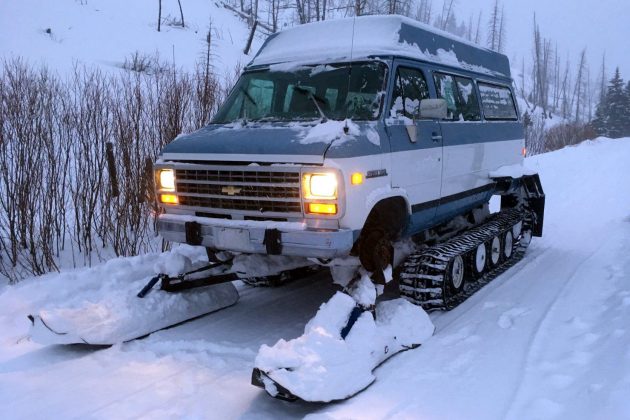

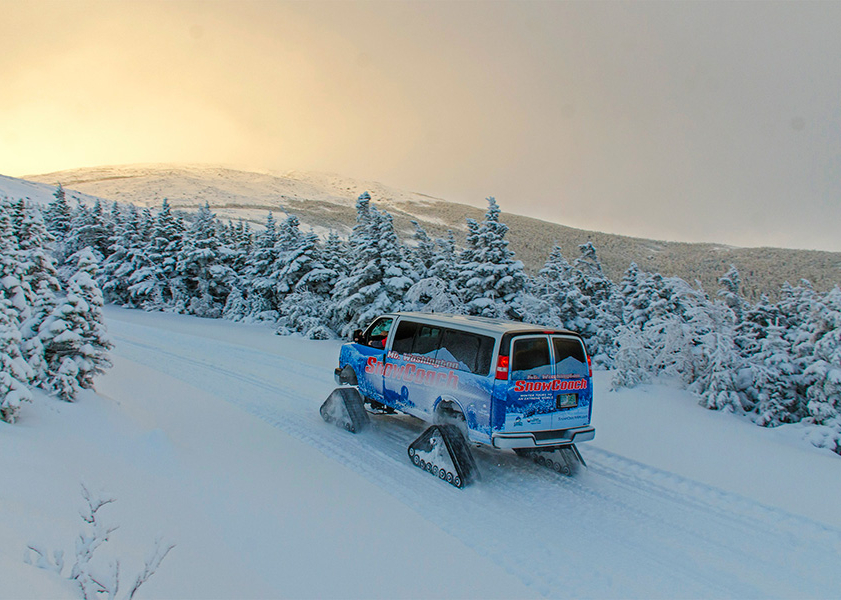
This category isn't exclusive to anything above, but it might be worth considering as a sort of modifier. In regions with cold, snowy winters, we currently invest a tremendous amount of resources keeping the roads drivable in all circumstances, and some of the practices we use are having catastrophic environmental effects. An alternative is to reference the past and embrace seasonality, including in how we travel. Our page on seasonal roads has a more thorough writeup of both the kinds of track and ski modifications which might be used to convert a road-worthy vehicle to travel over snow, as well as how the roads might be maintained. But this philosophy might also include flood-ready public transportation, ready to navigate minor floods or to serve as an evacuation fleet, or similar amphibious personal vehicles.
Vehicles as a Personal, Private space
There's a concept introduced in this video that adds another reason why people IRL are so attached to cars: because for many, a personal vehicle may be the only or primary private personal space they have. This circumstance may be reduced in a solarpunk setting, where housing guarantees could do much to alleviate this issue, but for near future settings, it's possible that there'll be a whole category of traumatized people who need a “mobile, safe, place”. Fiction is a good place to imagine and depict answers to show people today that another world is possible.