
High Context Living
High Context Living refers to the sort of custom, DIY systems favored by offgrid homesteaders and people without other options, which trade user-facing complexity and unique quirks/challenges for significant efficiency and lower cost in parts and materials.
I think the best way to introduce this concept is by using the zine that named it (included below with permission of the creator (who wished to remain anonymous)).
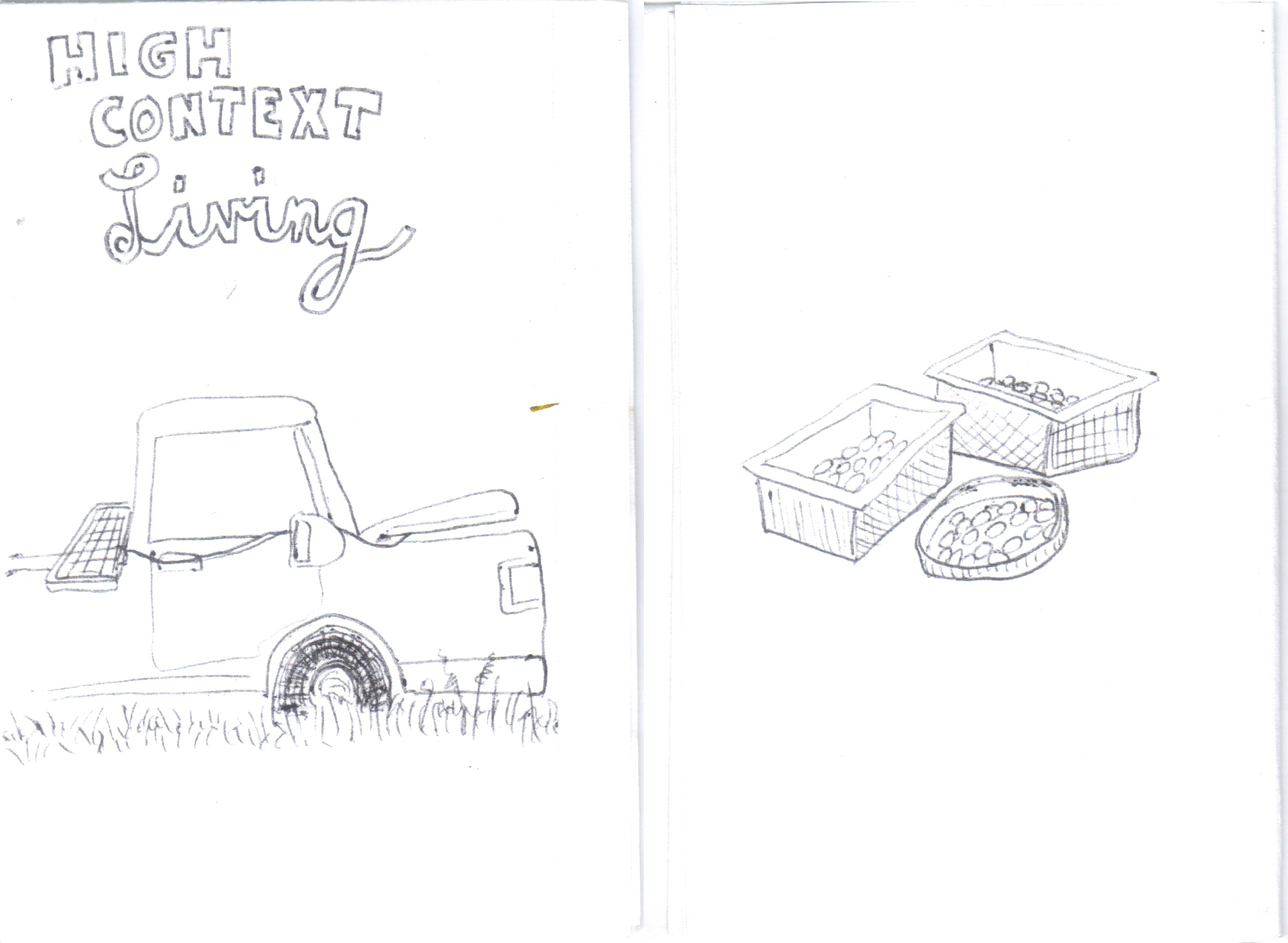
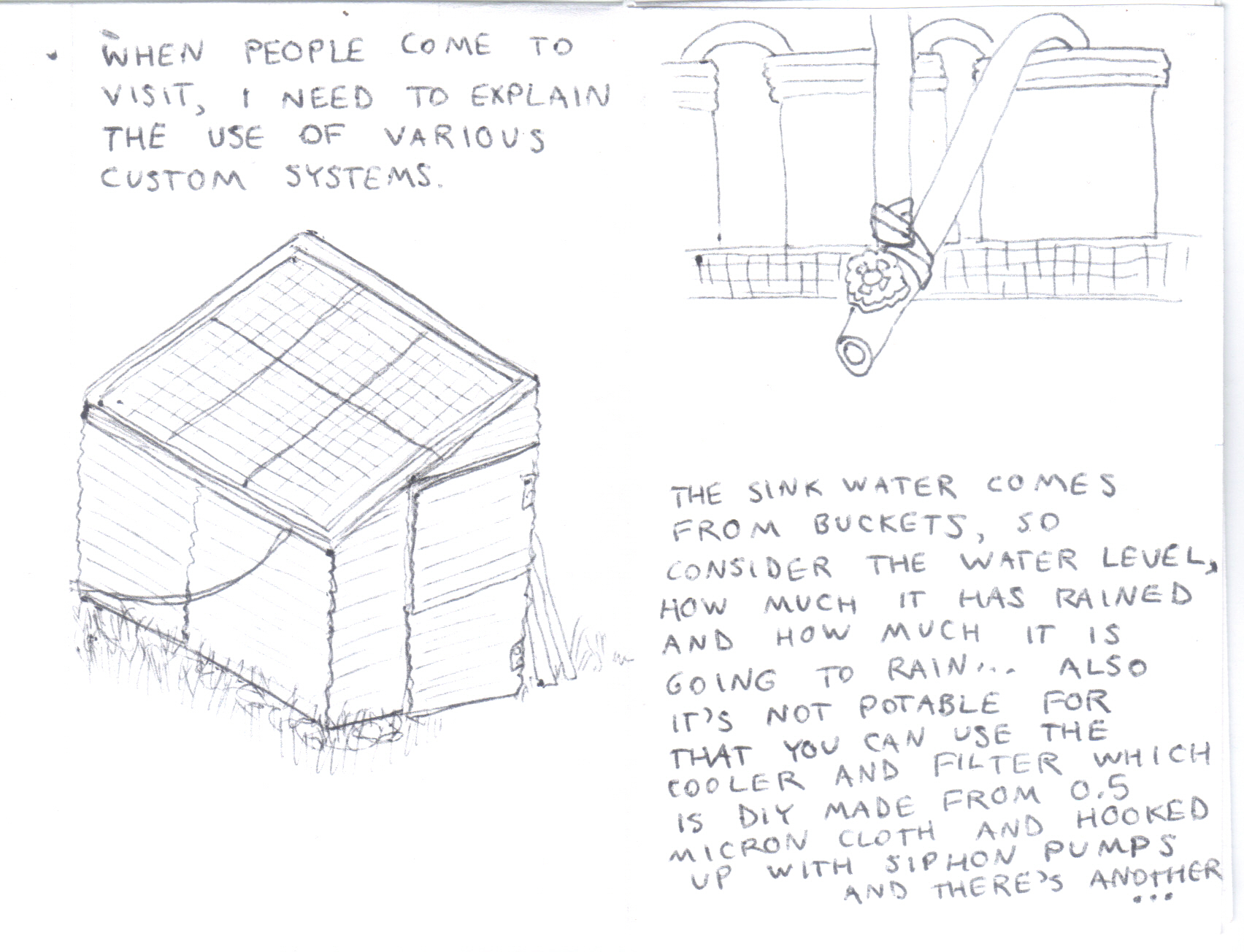
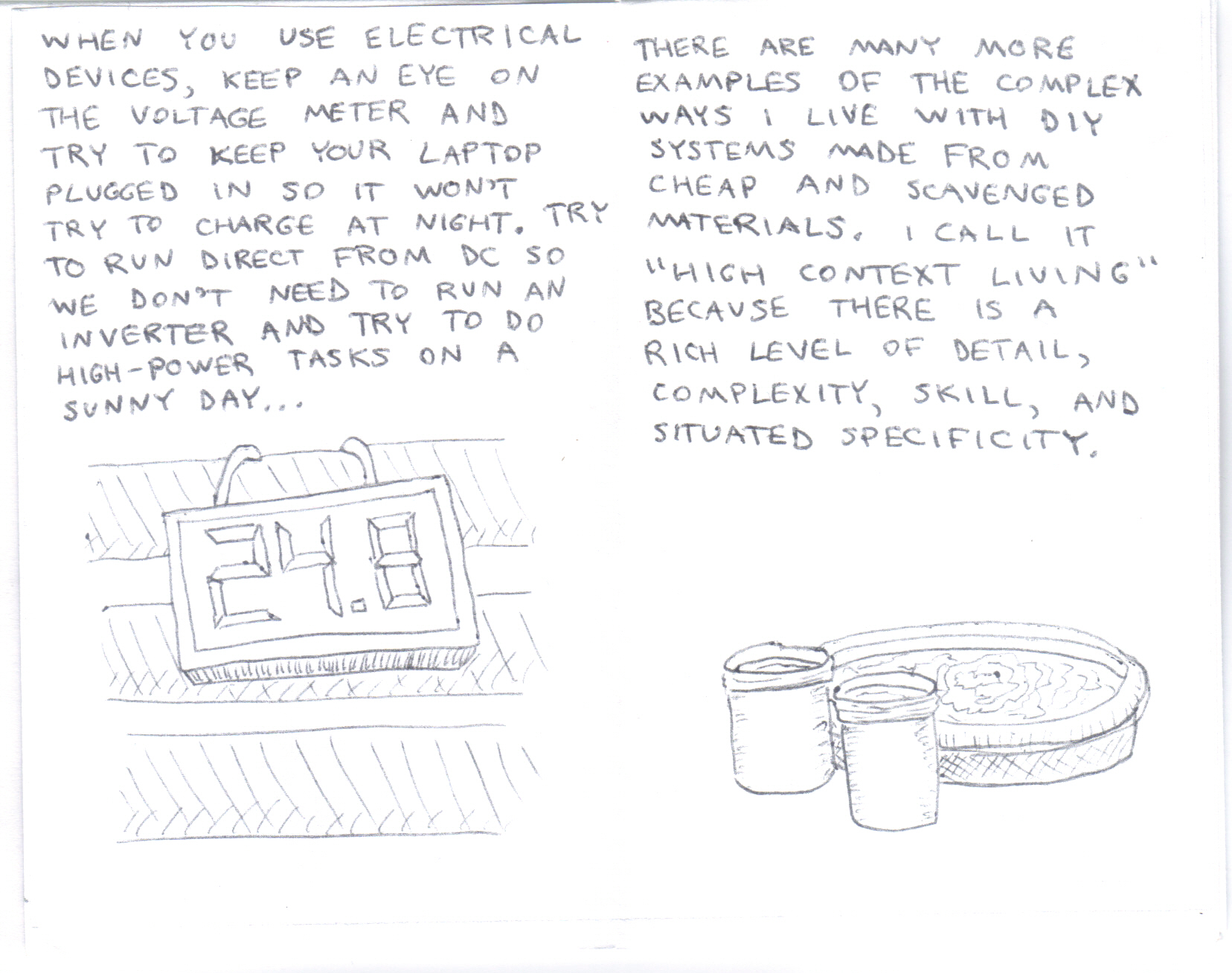
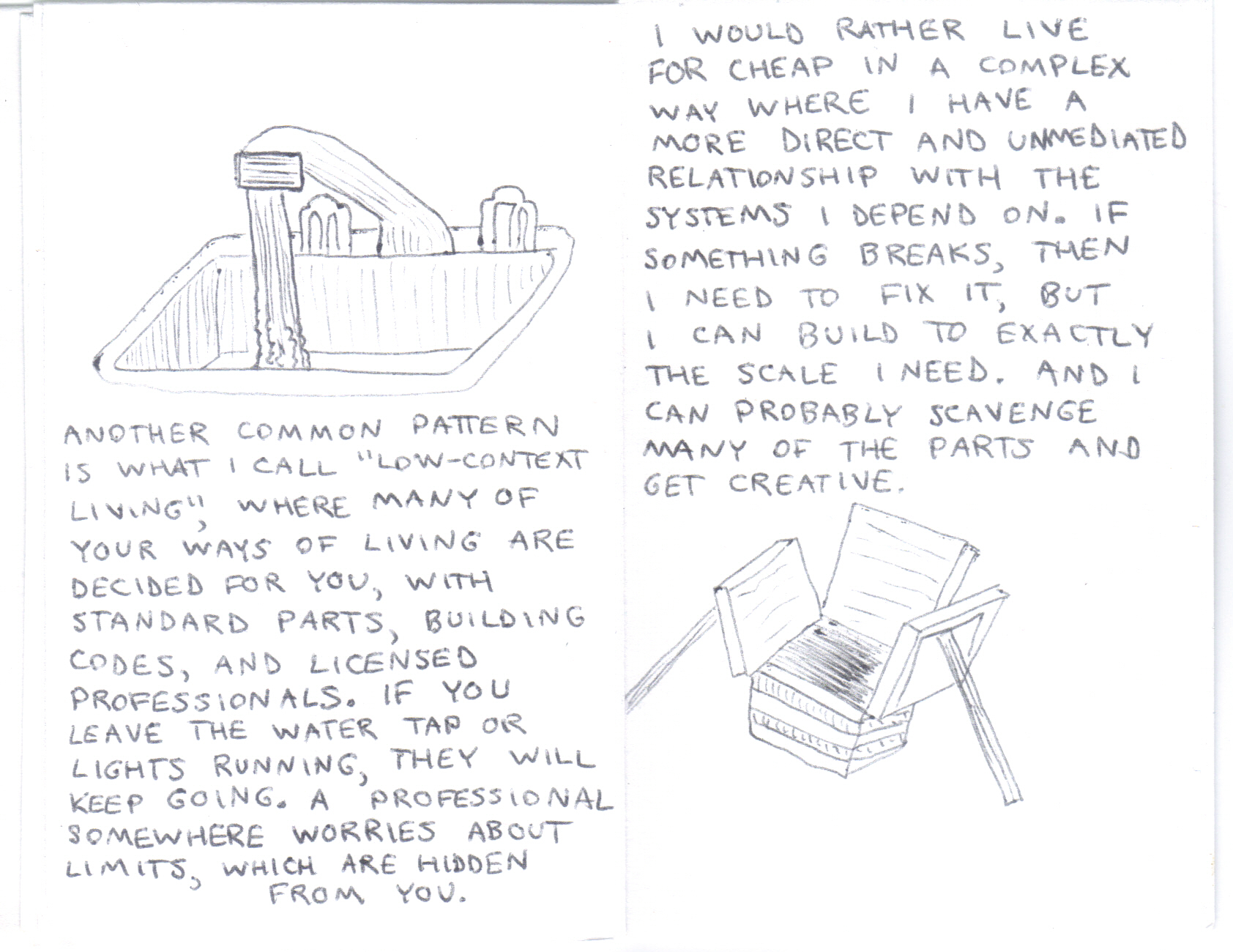
| Transcript of the Zine: High Context Living | |
| When people come to visit, I need to explain the use of various custom systems. The sink water comes from buckets, so consider the water level, how much it has rained and how much it is going to rain… also it's not potable. For that you can use the filter which is DIY made from .5 micron cloth and hooked up with siphon pumps and there's another… when you use electrical devices keep an eye on the voltage meter and try to keep your laptop plugged in so it won't try to change at night. Try to run direct from DC so e don't need to run an inverter and try to do high-power tasks on a sunny day… There are many more examples of the complex ways I live with DIY systems made from cheap and scavenged materials. I call it “High Context Living” because there is a rich level of detail, complexity, skill, and situated specificity. Another common pattern is what I call “Low-Context Living,” where many of your ways of living are decided for you, with standard parts, building codes, and licensed professionals. If you leave the water tap or lights running, they will keep going. A professional somewhere worries about the limits, which are hidden from you. I would rather live for cheap in a complex way where I have more direct and unmediated relationship with the systems I depend on. If something breaks, then I need to fix it, but I can build to exactly the scale I need. And I can probably scavenge many of the parts and get creative |
How Does High-Context Living Fit Solarpunk?
High-Context systems can be far more efficient than Low-Context ones, usually when they're paired with lowered expectations and careful management of resources.
These systems often strive for efficiency even at the cost of reliability, let alone convenience. When you know you only have a certain amount of water available to you, you're more likely to fix or disconnect a leaking faucet. If you only have around 400 Wh per day, you can't afford to leave lights on, or computers running when you're not using them. And if you do leave a tap or a device running there's often a hard limit on how much of the resource you can waste before it just runs out.
People who use these systems generally need to be more conscious of the seasons, the weather outside, how much it has rained lately, and the cycle of day and night. Many of the accounts and examples listed below mention that they like the sense of connection they feel to the world around them.
These systems' efficiency, their emphasis on DIY construction and scavenged parts, the focus on meeting local needs with local conditions, and the more personal link to the natural world are all very solarpunk.
In solarpunk fiction, places built around High-Context Living can emphasize salvage, seasonality, resourcefulness, a rejection of one-size-fits-all solutions, and generally add a lot of character and flavor to a scene. Their descriptions can also offer some useful opportunities for worldbuilding.
Tradeoffs
It's important to remember that there's a reason these systems are almost exclusively the domain of solarpunk, environmentalist weirdos (complementary), remote homesteaders, and people for whom the default, low-context alternatives are too expensive or simply unavailable.
They're more work, less convenient, and less reliable. And because they require much more involvement and skill from regular people, they can also be less safe. In examples below you'll see systems that require the end user to routinely sterilize their drinking water, electrical systems which require manual load balancing to keep from overcharging the batteries, and similar risks.
Even in a solarpunk future these systems likely won't be most people's first choice, especially in regions once controlled by wealthier, convenience-addicted societies with higher expectations.
And that's probably not a bad thing.
There are some important benefits to the systems that allow for low-context living. The standardization of parts and design, the safety and quality standards, the accessibility benefits from their ease of use, the efficiencies of centralized infrastructure, and the emphasis on expert-run operations are all good, admirable things which would likely be prioritized more by a solarpunk society than our current one. Regulations are written in blood and most of this complexity came about for good reasons.
It's just also worth recognizing that the places where low context living is the default also tend to consume far more resources per person, possibly (partly) because these systems are easy to use, seemingly without limit, and because they abstract away the complexities of operation and the sourcing of resources.
So where/why are these systems likely to show up?
These systems are already common in real life, in deliberately-offgrid homesteads, regions where the existing grid is unreliable or nonexistent, and remote areas of otherwise-developed regions where it is too costly or difficult to connect to existing utilities.
A solarpunk society would likely make advancements in sharing resources equally, and would prioritize providing electricity, clean water, sewage treatment, and internet to as many people as possible. But it's also likely that these categories will still exist to some extent even in the most aspirational setting, if only for practical limitations around distance.
These categories could also expand to contain far more people/places, depending on your setting's backstory. If the solarpunk society is a recovering one, perhaps rebuilding after war, climate disasters, societal crumbles, or some combination thereof, then it's possible that supply chains broke down, that even well-established municipal services became unreliable, and that people had to set up at least backup alternative systems to get by.
These may be temporary fixes that are fading as society recovers and reestablishes the low-context alternatives, or they might be elaborate DIY systems that people are not just comfortable with, but even proud of, with no plans to go back to how things were before. It's very possible you'd see both even in the same place.
Because these places would likely be extremely varied and idiosyncratic, we can expect that it'd be both polite and practical to ask questions before trying to use someone's sink, or toilet, or outlet when visiting.
Examples of High Context Living
The following sections will attempt to gather good IRL examples of the sort of systems people build when they're living off grid or trying to reduce their consumption. With any luck, they will provide inspiration and useful details for describing similar systems in fiction.
Some of the following links are to blog posts, others are excerpts from permaculture or off-grid forums.
Electrical Systems
One very common change in off-grid houses is to run as much off 12V DC as possible, including installing the cigarette-lighter 12v sockets commonly found in vehicles as outlets in a home. Low Tech Magazine does a good job of explaining why people switch to DC household power and provides a good post on some of the changes the writer has made to both their electronics and their lifestyle to make this work. But there are tons of other examples we can look to:
“Do as much with 12V DC as possible. Yes, higher DC voltages make more efficient use of wiring, but there is so much stuff you can get off the shelf that runs on 12V that that alone outweighs the possible need for more copper. You can get 12V LED “corn” bulbs that screw into regular light bulb sockets, so you can use whatever nice-looking light fixtures and lamps you want. You might have to order them straight from China, though. You can get mini versions of most kitchen appliances that run on 12V (truck stops are a good place to buy them). The cheap, easy-to-replace inverters are all 12V. Car adapters for all your electronic gizmos are 12V. You can use a 12V car stereo in your cabin or convert a boom box to 12V, as I did for Helen. You can also get good 12V refrigerators and freezers, although the better ones also come in 24V models. When you run all this stuff on 12V, you can leave the inverter(s) off most of the time, which saves energy and eliminates fan noise. I mounted cigarette lighter sockets in deep outlet boxes and made my own cover plates by punching standard blank cover plates with a Greenlee punch. A person could also use a step drill, especially in a plastic plate. Although there is no real standard for 12V outlets yet, and the code allows 240VAC outlets to be used for 12VDC in a building where there are no 240VAC outlets actually hooked up to AC, I prefer sticking with the most standardized thing out there, and that's the old cigarette lighter outlet. By having those outlets, if your friend comes over and wants to charge their cell phone, they can just plug their car adapter in and they're good to go.”
So it's possible that a standard-looking outlet in a house modified for DC could actually carry an unexpected category of power. In a house which has been modified in hard times by amateurs using available materials, it's even possible that different circuits would be carrying AC and various voltages of DC, following logic known only to the resident.
- For an example on a boat:
- For an example involving micro hydro generation:
“When I was still knee high to a grass hopper, my dad built a similar water wheel driven generator system in a stream behind our neighbour's property. They had a little permanent mountain stream from a strong fountain in the hill above the house. Built a little retaining dam with overflow. The 3” feeding pipe was built into the bottom of the dam, and fed the flow to the wheel about twenty meters downstream. The generator supplied the power to a bank of 6 truck batteries in a store room. The oom was a bit of an eccentric chap (and a stingy old fellow), he collected a bunch of old car light fittings and installed them all over the house. A 12v system. He powered them from the batteries. I know the living room, kitchen, store room, dairy and garage's lamps burned permanently, to keep some load on the system and prevent overcharging the batteries. It was crude, but free.“
- Here's a similar project converting a 12v household to 24v with a great level of detail:
High Context expectations: DIY electrical systems may require careful management of the load connected to them, in order to balance power available from generation and storage. This could include rationing power use at certain times (such as night or cloudy days for solar, or drought seasons for small scale hydro) and used freely at others. This requires a more careful awareness of time, weather, and season. These systems may also include nonstandard usage of existing hardware, such as some outlets designed for 240v AC being used for DC (or other outlets if they're not following the building codes), or appliances and lamps being modified to use 12v DC.
Clothes Dryers
There's something to be said for just drying clothes on a clothesline or drying rack, but there are also ways to make electric dryers more efficient, at the cost of complicating their operation a bit.
As Low Tech Magazine mentioned in the above article, dryers are one of the appliances which draw too much power for a basic, all-DC household. Even for a more technical setup with rooftop solar, large batteries, and an inverter, electric dryers draw a lot of power. Furthermore, by venting the hot, moist air they produce through the wall to the outside, they actually draw outdoor air into the household, which can make more work for whatever climate control is operating at that time. There are several designs which mitigate these issues by using solar thermal to produce the heat for the dryer. Some use dedicated solar hot air systems, others draw hot air from an attic.
- The solar collector version:
- Examples of dryers drawing hot air from attics:
High Context expectations:
Someone who wants to dry clothes in one of these modified dryers would have to remember to wait until later in the day when the heat source is hot enough. Season and recent weather may also impact their effectiveness. In regions with cold seasons, the person who owns such a device might disconnect it from its heat source and return it to normal function in the winter, or cease using it altogether if sufficient power isn't available.
Water Systems
- This offgrid, solar pumped, gravity driven 1000 gallon running water system is a good example for setting up unconventional but effective plumbing:
- A friend in Romania described an arrangement where their house was connected to a household well, municipal water, and to a rainwater collection tank system which was set up by locals with no real official review or approval. The rainwater collection system was sited uphill from the village, using gravity and underground pipes to provide water to a collection of houses, mostly for summertime garden watering. Switching from one source to another requires turning valves/switches outside by the well:
“There's also a natural spring just about dead center in the village. It's constructed around just enough for easy access, stairs and a stone parapet to prevent collapse etc, but otherwise it's just water shooting out of the ground. In case of need any of us can just go down and fill up on free water and it is totally drinkable. It's just a pain to haul water up the hill. Especially for older people. Yeah we definitely have a lot of water options now that I think about it :))”
“But I think that happens when you don't have any perfect, perfectly reliable single source. You end up having a bunch of ones for different situations. I don't think we're ever meant to rely on one single source for everything.”
Food Storage Systems
This solar-powered, no-battery refrigerator setup made from a chest freezer is a good example of storing food for as little energy as possible:
Heat
Low-context systems like heat pumps can make managing interior temperatures extremely easy and quite efficient. But when it comes to producing heat efficiently, solar thermal systems can be both cheap to implement and extremely efficient, though they still add some complexity:
- Solar Hot Air systems can be useful for winter heating, food dehydration, or any other daytime space-heating goal. These can be DIY or factory made. Typically they are set up with an electric thermostat (or two, one to check that the interior of the heat panel is hot enough to warm the designated space, and the other to check that the designated space is cool enough to need it, the second is optional). But there is still some complexity in adding these systems, closing the vents and covering the glass in the summer.
- Solar Hot water can be as simple as a length of hose coiled in the sunlight or as elaborate as vacuum-lined rooftop tube systems carrying antifreeze-based heat transfer fluids through a heat exchanger to provide warm water even in winter. Some of these systems can be seasonal, and must be disconnected before temperatures drop below freezing. Either way, the water only heats to a comfortable temperature at a certain time of day so you have to plan around that.
Cooking
There are a wealth of Solar Cooker designs designs used all over the world to cook food using only heat from the sun.
There are a ton of ways to cook with sunlight, there's a vibrant DIY community and hundreds of designs to fit almost any circumstance, requirement, or starting materials.
- Two interesting variants to call out: there are some designs that allow for fairly traditional ovens. Most solar cookers are more of a replacement for a camping stove than a kitchen oven, but even that can be done: This system appears to use a series of reflective troughs on the roof to heat a transfer fluid running through a tube and conveys that down to a fairly traditional convection oven. While a Scheffler reflector is a huge mirrored dish positioned outside a building to bounce light through a hole in a wall into an oven.
High-Context Expectations: You generally need clear skies and they get less and less effective at higher latitudes. You also need sunlight - this might seem obvious, but think of how many changes you'd have to make if you could only cook when it's light out. No hot breakfasts (at least for much of the year in certain latitudes), no more bakers hours getting food ready before you open. Solar cooking and baking are done exclusively during the heat of the day.
Other
Municipal compost is low context - food and yard waste goes in, overbaked nutritious dirt comes out. Home composting requires much more context but produces actual living soil