
Work in Solarpunk Settings
By its very nature, a solarpunk world is almost guaranteed to have a culture which is significantly different from our current one. An emphasis on degrowth, ecological responsibility, and just the realities of existing within a closed system necessitate changes in how we conduct many aspects of our lives. Work - from what work is done at all to how it is conducted, will be a big piece of these changes.
When I was helping with the post-scarcity setting of the solarpunk TTRPG Fully Automated, we found ourselves casting about for a way to name the work people feel compelled to take on when they have the freedom to do nothing - the chosen purpose, the full time hobby, the projects you pursue because you want them to happen, as opposed to the IRL job you're compelled to get and cling to because our society will otherwise withhold food, shelter, and healthcare. In the end we settled on 'calling' and I feel it's a decent way to distinguish this sort of truly voluntary work, but also to hopefully make it apparent that not everyone finds theirs, or picks just one.
This page will attempt to lay out the framework I use for sifting what I feel are believable callings from present day work under capitalism.
As with every page in this wiki it's a work in progress - if you'd like to make additions or corrections please reach out!
Problems with work today
If you're interested in this topic, I very much recommend reading David Graber's Bullshit Jobs, either the short essay in the opening or the entire book, which is freely available on the Anarchist Library. The central premise is that there are a tremendous number of jobs of varying (but usually considerable) prestige and pay which simply don't have to be done, while necessary work (think COVID-19 essential workers) is often systemically and culturally derided and poorly-paid. Whether you agree with his full analysis, the book can give us a bit of a framework for identifying types of work which hopefully won't exist in a solarpunk society. It also identifies a number of unnecessary, unpleasant aspects of necessary jobs which could be safely removed, both improving the experience of doing those jobs and reducing the amount of time devoted to them. This can help us lay out some of the ways work in a solarpunk society would be different than it is today.
These problems include (but certainly aren't limited to):
- Hierarchies which permit or even encourage abuse (both within the organization and by outside clients/customers).
- Work where even the people doing it can't convince themselves it matters (but are often compelled to pretend that it does) or which is actively harmful.
- The need to pretend to be busy when you're not. A work culture built around buying and owning an employee's time often leads to bosses and managers who feel workers are stealing from them if they're not visibly working every minute, even if they know there's nothing for them to do in that moment. They'll then make up busywork tasks for them to do or tell them to 'look busy.' This act of compulsory play-pretend is deeply frustrating and unnecessary.
- Performative discomfort - the idea that it's unprofessional for a cashier to sit down when they're not ringing someone up, for example (or even if they are).
- Needless bureaucracy/processes/hurdles, which take time from necessary work and often exist to justify the roles of various people higher up the hierarchy.
For much of this, you can run a quick check just by asking “would someone put up with this if they were a volunteer?”
What Work Will Get Done?
There's a common thread in at least American thinking that says people are inherently lazy and must be compelled into becoming janitors or landscapers or waiters with the threat of poverty, homelessness, or a lack of health care.
Generally it's quite possible to find people who genuinely enjoy waiting tables or tending bar, delivering food, etc. The book Bullshit Jobs cites several people who mentioned leaving a stressful, pointless office job for a lower pay job cleaning buildings, where they felt like they were at least making a contribution.
What people generally don't like is how the work is done today. You can find plenty of people who like farming but very few who desperately want to be field laborers in a huge, quota-driven, productivity-obsessed megafarm. It's almost certain that many, perhaps even most people serving drinks or scrubbing toilets today don't love their work, but it's also quite likely that there are others who would cheerfully take it on but feel compelled to do other work they don't like because it provides better pay and benefits (such as health care) which they need in our current system.
If these trades were properly compensated and treated with the respect they deserve as essential workers (as revealed by the COVID-19 pandemic) finding people interested in doing them should be easier. Especially if that respect involves freeing them to manage their own time, and removing BS activities like mandatory pretending to work, standing around for hours, or working through unnecessary bureaucracy, the actual amount of work society needs to find people to do may be much reduced.
In addition to these jobs, there are some categories of effort which don't generally get counted today but which we could easily add: people frequently volunteer to do tedious, or difficult tasks in their own time and for no pay at all already. They pick up trash, uproot and bag invasive plants, fill out grant applications for nonprofits whose goals they believe in, they write open source software, and they curate open source datasets like Open Street Maps and Wikipedia.
There's also a tremendous amount of work which should be done today, – especially in environmentalism – that just isn't done because it's not profitable or else it relies mainly on students, or other volunteers. Detecting industrial contamination, tracking and removing invasive species, work like this could easily qualify as a full-time solarpunk calling.
| A Note on Compensation | |
| Compensation as I'm using it here can be a pretty broad category. Money or the luxuries it would buy are perhaps the default to our way of thinking today. Commerce, indepent of capitalism is fine for many settings and can make for an easier understanding by the audience. If your setting is thoroughly post-scarcity, tokens of community acclaim are an interesting option. The book Murder in the Tool Library had a sort of augmented reality cyberspace overlay which most characters saw - and which was used to provide creative modifications/decorations to award people who made important contributions to their communities through their work. |
Decide the circumstances
When I first started gathering ideas and links for this topic, I was prepared to break things out by what kind of solarpunk setting you're aiming for. At this point it seems like many of these ideas around what work is necessary and how it'll be done are more universal than I'd expected but I'd still like to take a moment to discuss setting-based reasons/justifications.
Solarpunk settings often include some degree of universal basic income and robust social safety nets such as universal healthcare and protections from homelessness. If that applies to your setting, then people may have a tremendous degree of freedom to pursue their passion full time, even if it isn't profitable - especially as long as they're willing to scrape by on the minimum. (I think of this as the 'treat every character as if they're retired' sort of setting). There's more we can change though, and which probably would have to change just to get this far into a solarpunk transition.
This society would likely have vastly different priorities and more ways of tracking whether a way of doing things is worthwhile besides money. It would have to track externalities and other harms (such as ecological health/balance) in a complex tangle of metrics, likely including less-tangible but significant cultural/spiritual elements which don't show up well on balance books but which make for thriving communities. This would likely entail a different pace of life to facilitate reducing extraction, shipping, and industrial output overall for ecological reasons, and placing more emphasis on repair, reuse, and recycling already-available materials. This society would hopefully be better-suited than our current one to ensure that the benefits from automation and other technological improvements are actually distributed equally amongst the people doing the work, rather than hoarded by the people on top.
Bullshit Jobs estimates that something like half of all work currently done is unnecessary or actively harmful to the community/world at large. If this society aims to reduce 'productivity' even further to something which is actually sustainable long term, this collective workload could possibly be reduced even further. If your setting comes after a workers' revolution, much of this transitional work may already be done - in the present it should be enough that the workers in most places can manage themselves without installing a parasite class above themselves to siphon off most of the profits and worsen their working conditions. In this case, getting the work done on time and done well should be more important than the appearance of constant frantic activity or deriving ever-increasing profits from the same work.
On the other hand, if your setting is a hardscrabble, post-postapoclyptic place focused on rebuilding better, it could simply be that there isn't room for some of the problems our present day work includes. Workers may have more power/negotiating ability just because there are fewer of them and whatever work needs doing is too important to leave undone. Layers and layers of mostly-unnecessary empire-building managers might just be too hard/expensive to justify. In this case, the setting may be more of a doer-ocracy, where the work is whatever needs to get done, as decided and executed by the people who choose to do it, likely with very little oversight.
In some ways, work in this setting might look more familiar to a modern audience and may not be the result of deliberate/revolutionary change. The challenge may be more around depicting communities which have built/maintained good collectivist practices, to provide for each other and to resist strongman-types who would drive another return to feudalism.
Where to look for examples of solarpunk callings IRL
One of the best starting points here is to ask what would you do if it didn't have to be make money?
But there are plenty of real life examples to draw from too. Generally the common theme is in looking to what people already choose to do (despite our current society generally disincentivizing them).
The work people take on despite the conditions and poor pay
It's a common axiom that many important jobs like teachers and librarians are poorly paid while [insert socially-negative career here] is far better compensated. Yet people still put in years and years of expensive schooling to become teachers and librarians because this work is important and it calls to them. There are many other jobs which, while they may have less drastic education requirements, need to be done and done well for society to function.
This, I think, is a category of work which would thrive in a solarpunk society. With appropriate compensation and support (both of which are all-too-frequently lacking) these jobs could be made more rewarding beyond their obvious necessity. By eliminating bureaucratic hurdles and empire-building which have begun to infest most institutions in the last few decades, they could be improved further still by giving people back their time and ability to manage their own work.
The following list is far from comprehensive, and is not assembled in any particular order:
- Teachers
- Librarians (this role may be far more common in a library economy, albeit with much different skill requirements, as people working for tool libraries, or kitchenware libraries would provide different information than librarians for books and other media)
- Researchers/scientists (who often encounter a similar degree of education requirements/debt and poor pay IRL)
- The paid staff hired by nonprofits - who could easily take their skills to the private sector but who choose to work for less because they believe in what they do. Land conservation, food banks, housing assistance, etc. The staff are often a critical part of ensuring a volunteer-supported organization has the resources and organization necessary do pursue its mission.
- Firefighters and Paramedics (compensation varies wildly, but can be quite low)
- Nurses
- Hospital Cleaners
- Garbage collectors, recycling workers
- Nursery workers and other childcare professionals
- Bus Drivers
- Store clerks and other customer-facing personnel
- Cooks, dishwashers, and other restaurant staff
- Translators
- Industrial manufacturing personnel
- Construction - and Deconstruction - tradespeople
- Shipping personnel
- Soldiers often appear in these lists but that's quite possibly an entirely separate issue for a solarpunk writer
This page isn't delving into the economies of solarpunk settings, I personally tend to use a mix of a library economy with various currencies for things people want beyond what's guaranteed or easy to source secondhand.
Work people already volunteer for
This is another easy one - if people are already voluntarily doing work for free while living in a system which is all about money (right down to your very survival), it's a safe bet they'll be doing it in a more solarpunk world too.
This is far from an exhaustive list but hopefully it'll provide some examples and perhaps inspire your own ideas.
- Curating/contributing data in open source projects like Wikipedia or Open Street Maps.
- Contributing to open source software projects like various Linux Operating systems, Libre Office, Lemmy, Reticulum, and so many others!
- Guerrilla urbanism where people install code-compliant crosswalks or build benches and bus shelters. Or even DIY bus schedule displays.
- Volunteer Accessibility Auditors review buildings (and even trails) for compliance with accessibility requirements. Some US states already provide training on how to do this work.
- Building, coordinating, and participating in mutual aid networks.
- Volunteering at food banks, cooking food, washing dishes, transporting food/supplies to members of the community
- Building/improving homes, (the most well-known outlet for this work in the US is probably Habitat for Humanity)
- Citizen scientist crowdsourced volunteer efforts:
- The Audubon Society does numerous volunteer-based events like participating in the Great Backyard Bird Count. One of the things that convinced me early on that people will find productive ways to fill their time was my local chapters' participation in the fall migration count. Every year in October they pack snacks and birding gear and camp out on birdwatching platforms throughout New England, keeping track of migratory birds and teaching anyone who stops by for free. It's hard to describe the enthusiasm of the volunteers, their excitement to share their fancy scopes and both point out cool birds and to talk about them. I imagine many would love if they could do this more frequently but free time is often a limiting factor.
- There are similar counts for moth- and butterfly watchers!
- NASA lists 42 different citizen science projects on their website - people classify images taken by the James Webb Space Telescope, photograph clouds, classify images from trail cameras, monitor their local air quality, report landslides, inspect photographs of the asteroid belt, report water levels in lakes, search for exoplanets, classify light curves from gamma ray bursts, and much more.
- Much of the work of fighting invasive species is currently carried out by volunteers. They form work parties harvesting and bagging garlic mustard, or spend summer days sitting by boat ramps waiting to inspect people's boats and trailers for milfoil to ensure they don't spread it to uncontaminated waterways.
- Many museums, such as the San Diego Maritime Museum and Battleship Cove, rely on volunteer docents, guides, and maintenance personnel. Some even field volunteer crews while sailing. This is likely a common structure for museums with large structures to maintain (ie: marine, train, aircraft, architecture).
- Building, managing, and contributing to online communities. If you think of the scope and scale of some of the online resources provided by tech support forums, or Buy it For Life communities, this represents a sort of amateur information sciences/curation/expertise role. Similarly, managing/moderating local community Free Groups such as Buy Nothing, Freecycle, or Everything is Free can be an excellent contribution to a community.
- The 3D printing scene has a remarkably active community of people designing and publishing and iterating on 3d models which they usually make available free and open source. Anyone can download their files and print them out. In a solarpunk setting this could represent an entire new model for manufacturing.
Imagine if these entries and anything you'd add could be full-time work in your setting.
In addition to volunteer work people are already doing, a solarpunk society may see a comparatively-high number of people taking on voluntary tasks as they utilize newfound free time and personal safety/stability. For example, my local swap shop is mostly staffed by retirees and a handful of working-age tech people whose jobs provide both financial stability and free time. I think if those conditions were available to a wider swath of the population, far more people would be involved in projects like these.
Art and other activities currently relegated to hobbies
There are a number of callings which our current society scoffs at until you reach a certain level of success. Artists of all sorts, musicians, athletes, and similar are basically treated as fake jobs until the right combination of luck, connections, time for practice, and sometimes innate ability, work out just right. It's quite possible that a solarpunk society would experience an explosion of activity in these domains, especially if your setting is post-scarcity, or at least has robust social safety nets, as this would leave far more opportunities to work on art, to make things, to study for its own sake, to learn an instrument, travel to play gigs etc.
A far-from exhaustive list of possible full time callings includes:
- Painting in various mediums
- Digital art
- Music in probably every genre and some not yet discovered
- Filmmaking again, in probably every genre and some not yet discovered
- Writing
- Research
- Pottery
- Fabric arts
- Sculpture
- Metalworking
- Woodworking
- Indigenous Arts (there's a ton of different traditional practices being explored in really interesting ways already)
- 3D modeling
- Baking
- Gardening (possibly some really advanced stuff)
Depending on just how post-scarcity your setting is, you might have people who fulfill the conservative fears mentioned above and choose to spend their time in a consumptive role, such as watching film, or playing games full time, (whether that's videogames, a 24-7 LARP, or similar). Play is an important part of who we are as people, and a big piece of our health. A solarpunk society might embrace this as a worthy calling, though it could also be a useful point of contention within a setting depending on what else needs to be done.
In our current society, the worthiness of a career is generally decided (as with all things) by money. If you can make money at it, a professional gambler playing cards, or an artist painting canvas is considered acceptable enough. Historically, (though varying widely by place and time) wealthy people were often free to pursue leisure activities full time. Amusingly, the work-as-ethics mindset of our modern society now sometimes compels them to pretend that they work hard in order to justify their wealth. A solarpunk society may have to identify a different metric to determine the validity of someone's use of their time, or discard this judgement altogether.
Things you have to do
Even under a system with robust protections, there's no guarantee everything will go to plan or that people will be able to pursue their callings at all times. People may spend time recovering from an injury, or working through trauma or other conditions. They may have to take on caregiving for a loved one (often called hidden labor, this work often goes untracked/unpaid today). Very much related, they might spend years doing childcare full time. A solarpunk society should recognize that this is valid labor which contributes to the community and common good and provide the necessary supports to do it.
Individual/community chores
This is a fuzzy category of work that falls short of being most people's calling but which still has to be done (unless your setting has a truly marvelous level of automation). It definitely has some overlap with previously mentioned examples but I think it's worth calling out that most people will labor outside their calling (if they have one) at least some of the time.
When this work falls primarily on (or is dumped on) one member of a household IRL it often is full time work or longer, often minus the compensation and prestige of employment. Historically much of this work (such as cleaning house, clothes, and dishes, preparing food, tending crops or at least a garden) was assigned to women. And when the work was partially automated through appliances, societal trends and social pressures often made this labor more elaborate, as if to use up any time saved.
In a solarpunk setting, (especially one with more free time overall due to a reduction of unnecessary work, harmful work, and through the equal distribution of benefits from automation) chore labor would likely be divided more equally amongst members of a community (be it at the household/communal living level, neighborhood level, etc, whatever makes sense for your story).
The disbursement of this work will need some flexibility around physical/mental ability, preferences, skills/specializations, etc. But it's important to separate this work from hierarchies. In a solarpunk world it's probably safe to say that no one is 'too important' to clean their own workspace or living space (obviously with exceptions for hazardous/critical cleaning like in medical environments or mold remediation where you need a specialist to do it right). Someone might be too busy with other tasks sometimes, or they might be dealing with sickness or grief etc and being cared for by their community, but the normal expectation would likely be that competent adults tend to their environment and do their part of the community workload (whatever that may be).
This could be taking a turn scrubbing down a communal kitchen or weeding a rooftop garden, shoveling snow off a sidewalk, or doing other maintenance tasks. Older folks who can't do the more physical tasks often help with childcare, food prep, fix things, or provide advice/supervision.
And again the boundaries with the other work listed above are fuzzy. In real life, picking up litter could be part of a job (for example, with a US state Department of Transportation, or a city Parks and Rec department), a community volunteer event (such as an Earth Day cleanup), a personal volunteer project, or even a chore (if, say, trash keeps blowing into your yard from the freeway). It's very likely you'd see a similar overlap in a solarpunk world.
How does this work look different?
One way to think about it is what if almost everyone was a volunteer? The work that remains should be the stuff people will volunteer for and should be done at their own pace. Often this will look like bursts of frantic activity with longer spans of rest - or time spent doing something else entirely. The concept of a workplace owning someone else's time and requiring them to pretend to work while on the clock should be long gone here.
At the free stuff Swap Shop where I volunteer, over a dozen people put in time sorting items, stocking shelves, and managing 'customers' browsing the displays or looking for specific items. In the electronics department five people sort, test, fix, and clean grungy, sticky, ewaste before putting their finished work out on display for people to take. It's the happiest 'job' I've ever had.
When we're open it's structurally similar to being a store clerk: stand behind the display tables and answer questions, help people find things (we often actually do have what they're looking for 'in the back'), carry heavy items for people, provide information on the 'wares on display. We sort electronics as they come in, refill baskets of cables and drawers of laptop chargers from our stockpiles, and stand around and talk with each other or the 'customers'.
The biggest difference is in how people treat you and how it feels to work. It's not an undignified job harassed by management and customers alike. When everyone is a volunteer there's no real hierarchy - we're here to help, not serve. The people on either side of the counter could switch places and may even do so based on the day of the week! When we have to tell someone we don't have what they're looking for, they smile or shrug and say they'll check back next time. There's also no micromanagement, no “if you've got time to lean, you've got time to clean” entitlement from the organizers to owning your time while you're there or treating you like a thief if you're not busy.
So solarpunk workers should be respected for contributing to the community and for being part of the community. Their work should be as non-hierarchical as possible, as voluntary as possible, as safe/comfortable as possible, and as self-directed as possible. If there's a bureaucratic aspect -especially within a job, as opposed to navigating an external org's requirements- it should generally be limited to tasks someone could be convinced is worthwhile for them to do, rather than something they can be compelled to do by a manager who doesn't mind wasting their time. So writing grant applications for the organization's mission still probably fits, but you might need a pretty compelling reason before you start filling out weekly or daily reports on your own productivity.
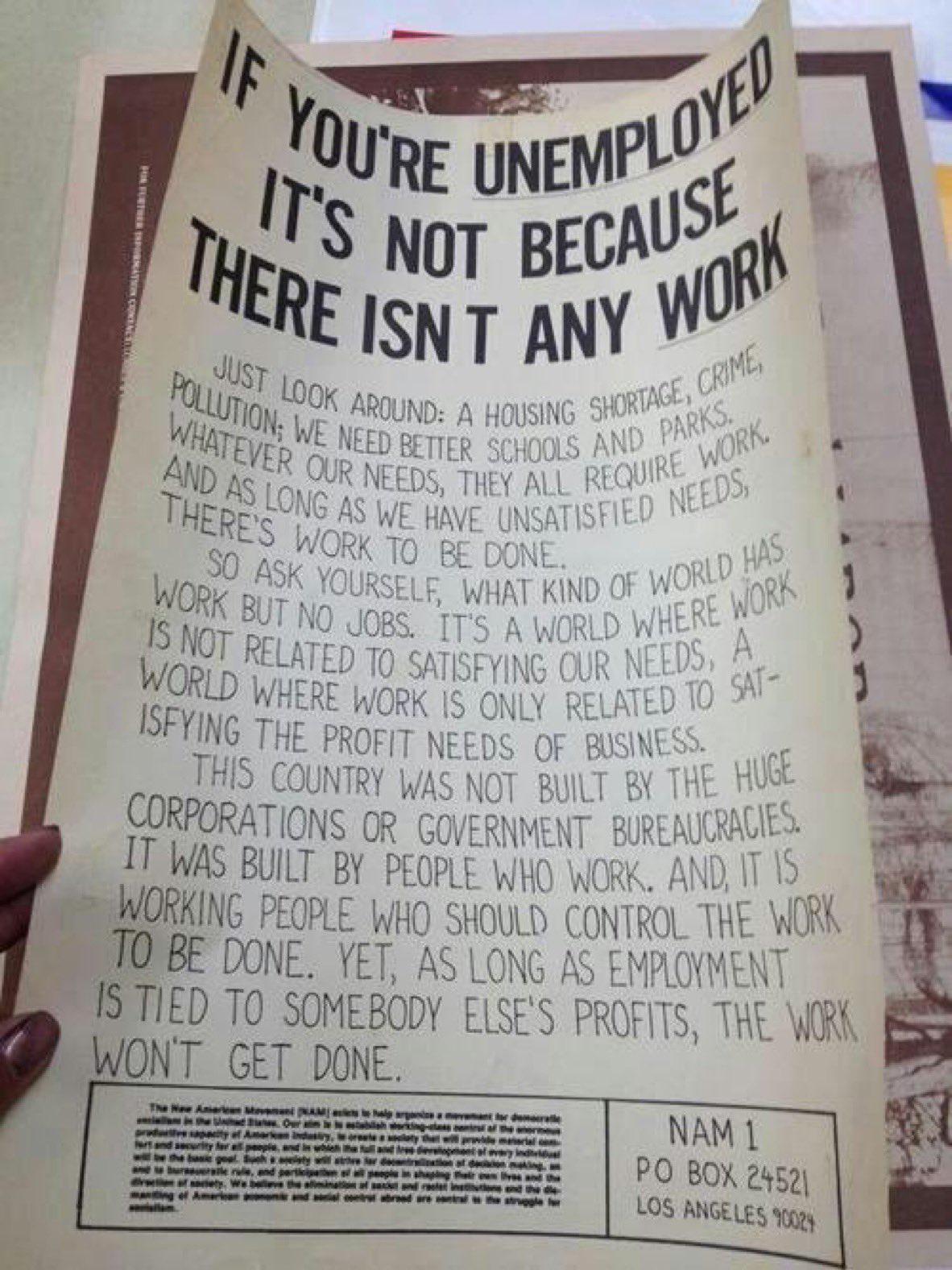 Flyer from the The New American Movement (NAM)